240z Better-Performing Disc Brakes
You can have better street brakes without resorting to expensive upgrades
The disc brakes on the 240z were fairly decent when it was built. Many cars back then still used drums, so discs were considered cutting edge. What worked in 1970 isn’t so great today. Modern cars have far better braking ability thanks to continued research and development. New calipers have larger pistons, the master cylinders are precisely sized for the application and the vacuum-assisted boosters are more powerful. Disc brakes work by squeezing the rotors tightly. The pressure of the pads against the disc provides the braking ability. In the past, “metallic” or “semi-metallic” pads were used because they created friction, which compensated for low pressure generated by the not-so-great master cylinders. They worked, but at the expense of the rotors, which didn’t last very long because the metallic pads literally ground them down. Pads today are “organic” or “ceramic”, which pretty much eliminate rotor damage. Those type of pads are on your Z right now, instead of the original semi-metallic, which means your brakes aren't as good as when the car was new.
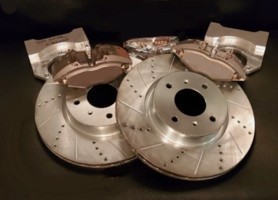 Upgrade options are available. Some work quite well but are expensive. Specifically-designed systems using vented rotors, multi-piston calipers, and a larger master cyclinder are supposed to be incredible, and for about $1500 in 2026 they’d better be.
You can adapt Toyota 4x4 calipers for about $500. It's supposed to be an improvement but there's no data to prove a reduction in braking distance. People who did the swap expected it would be better, and claim it is, but that's referred to as a "self-fulfilling prophecy" and is a terrible way to make decisions.
Additionally, if you're using the stock 14" wheels, the Toyota calipers won't fit.
The only real difference the conversion makes is for road racing. You'll be able to use vented/slotted rotors, which significantly reduces brake fade, but the braking distance itself doesn't change.
Take a look at my analysis page here to see how the Toyota conversion might make your brakes worse.
When the 240z was introduced, it came with 165 HR 14 tires, which is equivalent to a modern 175/70 R14. They were crossply/radials, typcally from Bridgestone or Toyo. The rubber compounds were harder, meaning less traction, which in-turn meant a longer stopping distance, so modern tires will obviously decrease that distance. Here's what I found for the original distance according to then-current magazines:
- 151 feet from 60 mph per Sports Car Graphic in March of 1970
- 287 feet from 80 mph per Road & Track in March of 1970
- 125 feet from 60 mph per Motor Trend in August of 1972
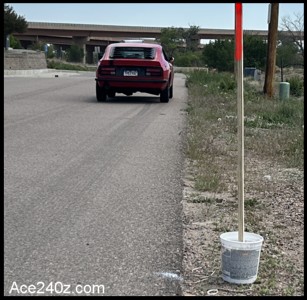 I did some distance testing myself because I want to compare different pads. My car is currently equipped with stock rotors, stock calipers, a stock master cylinder and 195/70 R14 tires, so the only variable is the pads.
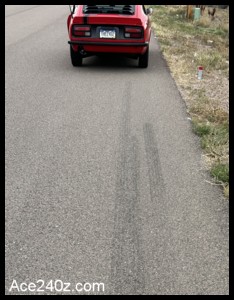
A local warehouse district has a road that doesn’t get much traffic. I used a red post as a marker for the "hit the brakes" point and measured the distance for each run.
I started with my existing pads and did 7 passes at 40 mph. I discounted the shortest one and the longest one, added up the rest and divided it by 5 to get an average distance of 68 feet.
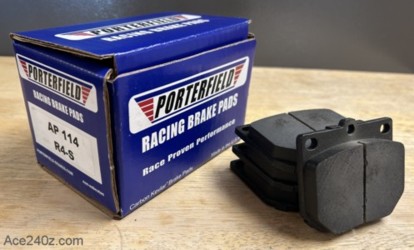 According to racer/builder Jeff Winter, a three-time national champion and a divisional/regional champion 32 times, the best street brake pads are Porterfield AP114 R4-S.
Here’s how Zeckhausen Racing describes them: “They are designed for heavy-duty street driving, with better fade resistance and lower dust than stock pads. Rotor friendly, low noise, good for autocross and rally. May be used for light to medium track duty.”
I asked Porterfield about how to bed-in the pads. Their response was the pads are "already" bedded-in, so drive 100 or so miles without any heavy braking and they'll be fine. That makes zero sense. Bedding the brakes involves adding a slight amount of pad material to the rotors, which will noticeably increase braking ability, and that's done immediately after installation. Their response makes me wonder if their pads are really better than stock, or the person replying to my email was simply clueless. I suspect the latter.
$128 with shipping seemed like a win.
 Installing the Porterfield pads only took about 90 minutes. Click here for my brake pad replacement procedure page. They came with anti-squeal shims already pressed in place. According to Porterfield, anti-squeal grease isn't needed. I added some anyway but they still ocasionally squeal.
After a bunch of around-town driving and a 1,000 mile run to California, I returned to the same section of road and did the same exact test. The average distance after 10 runs was... 69 feet, so there was virtually no difference.
Either my original pads were better quality than I thought or the Porterfield pads aren't as great as they claim. Since I don't know where my original pads came from, or their composition, this isn't a 100% valid, test but it's a good example of how assumptions shouldn't be used for important decisions.
If nothing else, it's a good baseline to compare the Poterfields to other brands.
Jeff Winter's experience and advice carries a lot of weight and I trust him unquestionably, but for a stock 240z/260z/280z the only difference Porterfield pads might make is having less money in your pocket.