240z Steering Rack Boots
They don't cost a long but can save a lot of money in the long run
 Unlike most cars in the early 70s, the Z series uses a rack & pinion steering system. There is a “pinion” gear at the end of the steering column that moves a toothed “rack” back and forth. It’s a fairly simple mechanism that doesn’t require much maintenance, but at the time it was considered a very "sporty" thing.
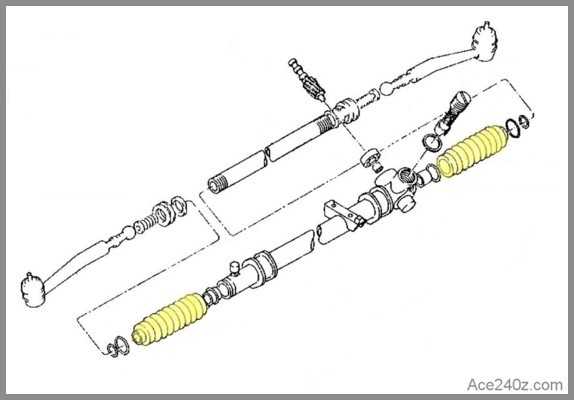
However… as you steer from side to side, the toothed rack is exposed and all kinds of sand and grit can stick to it, which could lead to damage and an expensive repair or replacement, but fortunately there are rubber boots (in yellow) that cover the exposed area and keeps it clean.
Over time, the rubber can become brittle and cracked and damaged. New boots are relatively cheap, but paying a shop to do the replacement can be pretty pricey. Thankfully you can do the job yourself with ordinary tools in less than three hours.
Keep in mind that after you replace the boots, you’ll need to get the wheels aligned. Any time you work on the front suspension, or get new tires, an alignment is essential. Most places offer a “lifetime” alignment option for about 2-1/2 times the cost of a single alignment. With the various upgrades on my car over the last decade, I’ve already had it aligned four times. Having just replaced the steering rack boots, and getting a brand new set of tires, it’ll go for a fifth time at no charge, so give that “lifetime” plan some thought.
Unlike most cars in the early 70s, the Z series uses a rack & pinion steering system. There is a “pinion” gear at the end of the steering column that moves a toothed “rack” back and forth. It’s a fairly simple mechanism that doesn’t require much maintenance, but at the time it was considered a very "sporty" thing.
However… as you steer from side to side, the toothed rack is exposed and all kinds of sand and grit can stick to it, which could lead to damage and an expensive repair or replacement, but fortunately there are rubber boots (in yellow) that cover the exposed area and keeps it clean.
Over time, the rubber can become brittle and cracked and damaged. New boots are relatively cheap, but paying a shop to do the replacement can be pretty pricey. Thankfully you can do the job yourself with ordinary tools in less than three hours.
Keep in mind that after you replace the boots, you’ll need to get the wheels aligned. Any time you work on the front suspension, or get new tires, an alignment is essential. Most places offer a “lifetime” alignment option for about 2-1/2 times the cost of a single alignment. With the various upgrades on my car over the last decade, I’ve already had it aligned four times. Having just replaced the steering rack boots, and getting a brand new set of tires, it’ll go for a fifth time at no charge, so give that “lifetime” plan some thought.
 Before doing anything, crawl underneath the front and spray some penetrating fluid (such as PB-Blaster or WD-40) on the locknuts for the tie rod ends.
Put a jack under the crossmember and use a pair of jackstands for protection in case the jack fails. Pull the wheels off and slide them under the car for another level of protection.
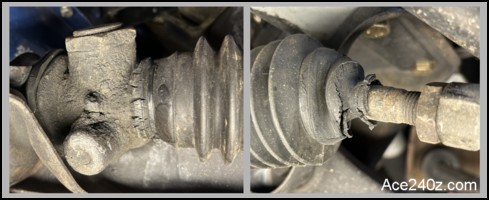
As you can see, my 10-year-old boots were in pretty bad shape. The one on the passenger side even had a rip in it. Remove what's left of the boots and wipe away any crud where they attach to the rack.
Before doing anything, crawl underneath the front and spray some penetrating fluid (such as PB-Blaster or WD-40) on the locknuts for the tie rod ends.
Put a jack under the crossmember and use a pair of jackstands for protection in case the jack fails. Pull the wheels off and slide them under the car for another level of protection.
As you can see, my 10-year-old boots were in pretty bad shape. The one on the passenger side even had a rip in it. Remove what's left of the boots and wipe away any crud where they attach to the rack.
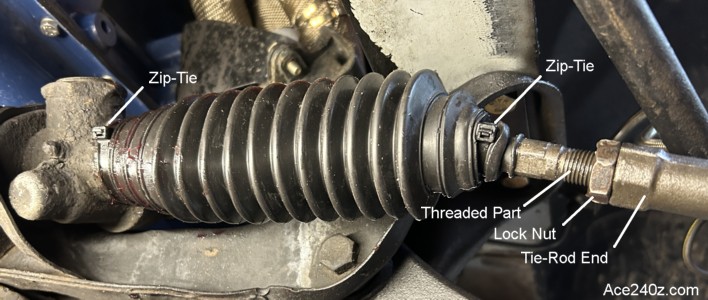 The rod ends have a 22mm lock nut - a crescent wrench works fine to loosen it - but the threads on the driver’s side are reversed to make it easier for the shop to do the alignment. Use a 13mm wrench to back the threaded part out of the tie rod end. Count how many times you turn the threaded part to pull it free because you’ll need to put it back in roughly the same spot to keep the alignment near the existing setting. You don’t need to be exact, by try to keep it close. Remove the lock nut.
The boots I bought were supposed to be an exact duplicate of the stock Datsun versions, but as I expected, they needed a little trimming. Give the exposed rack a fresh dollop of grease, then slide the boots over the threaded part, over the rack teeth, and stretch it onto the channel-shaped groove where the rack pokes out. It’ll take a little fussing to get it in place but make sure it’s seated firmly, then use a big zip-tie (it should come with the kit) to hold it in place. At the small end of the boot, make sure it’s past the area you used a wrench to remove the threaded end from the tie rod, and use another zip-tie to clamp it in place.
Put the lock nut back onto the threaded end, and put that part into the tie-rod end, and slowly wind it back into approximately the same spot where it was originally. Use the lock nut to hold it in place. Now you can do the other side.
Put the wheels back on, remove the jack stands, lower the car and then make sure the lug nuts are tight. Really tight.
Take it to get aligned, and you’re done!
The rod ends have a 22mm lock nut - a crescent wrench works fine to loosen it - but the threads on the driver’s side are reversed to make it easier for the shop to do the alignment. Use a 13mm wrench to back the threaded part out of the tie rod end. Count how many times you turn the threaded part to pull it free because you’ll need to put it back in roughly the same spot to keep the alignment near the existing setting. You don’t need to be exact, by try to keep it close. Remove the lock nut.
The boots I bought were supposed to be an exact duplicate of the stock Datsun versions, but as I expected, they needed a little trimming. Give the exposed rack a fresh dollop of grease, then slide the boots over the threaded part, over the rack teeth, and stretch it onto the channel-shaped groove where the rack pokes out. It’ll take a little fussing to get it in place but make sure it’s seated firmly, then use a big zip-tie (it should come with the kit) to hold it in place. At the small end of the boot, make sure it’s past the area you used a wrench to remove the threaded end from the tie rod, and use another zip-tie to clamp it in place.
Put the lock nut back onto the threaded end, and put that part into the tie-rod end, and slowly wind it back into approximately the same spot where it was originally. Use the lock nut to hold it in place. Now you can do the other side.
Put the wheels back on, remove the jack stands, lower the car and then make sure the lug nuts are tight. Really tight.
Take it to get aligned, and you’re done!
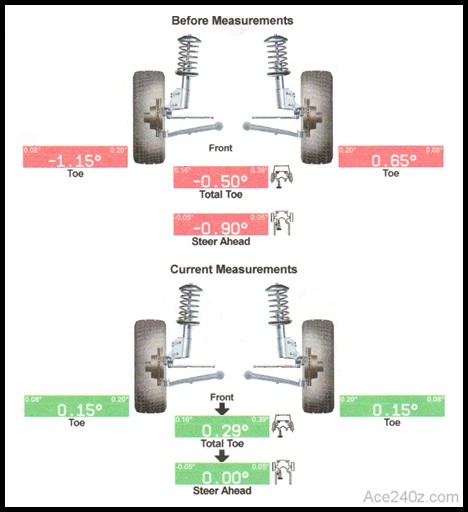 As you can see, getting the alignment was crucial. Despite being careful while reassembling, when I took the car for a drive the steering wheel was cocked to the right. Not good, but not unexpected.
Driving it a couple of miles to get new tires fitted, and a couple more miles to the alignment shop wasn't a problem, just awkward.
Before the alignment, the passenger side was turned 1.15 degrees inward and the driver's side 0.65 degrees outward. Now both sides are at 0.15 degrees, which feels much better.
New tires and new boots are two things off the never-ending checklist.
As you can see, getting the alignment was crucial. Despite being careful while reassembling, when I took the car for a drive the steering wheel was cocked to the right. Not good, but not unexpected.
Driving it a couple of miles to get new tires fitted, and a couple more miles to the alignment shop wasn't a problem, just awkward.
Before the alignment, the passenger side was turned 1.15 degrees inward and the driver's side 0.65 degrees outward. Now both sides are at 0.15 degrees, which feels much better.
New tires and new boots are two things off the never-ending checklist.